A successful online classifieds site is not a theme demo with empty categories. Buyers find useful ads in search. Sellers get replies. You clear the moderation queue in hours, not days. Fees come after that liquidity exists. This guide shows how to start a classifieds website with Osclass so those outcomes hold in the first 90 days.
Osclass is a free, self-hosted PHP and MySQL classifieds script (~7 MB core). You own the domain, database, and rules. It ships listings, categories, custom fields, accounts, and oc-admin. You still choose the niche, seed inventory, name a moderator, and prove mail and cron before you buy traffic. Install walkthrough: get started. Production stack detail: how to build a classifieds website. For a curated theme and plugin starting set, see the general classifieds setup on OsclassPoint.
Define success in ops metrics, not vanity pageviews:
Sites that skip those checks and jump to ads usually burn budget on empty filters, then blame the software. Osclass will not invent inventory or a moderation policy for you.
Complete these in order before paid campaigns. Softaculous or Installatron only drops files; they do not prove success.
oc-content; system cron (index.php -p cron -t minutely|hourly|daily), not Automatic CRON alone; SSL and payment return URLs without loops.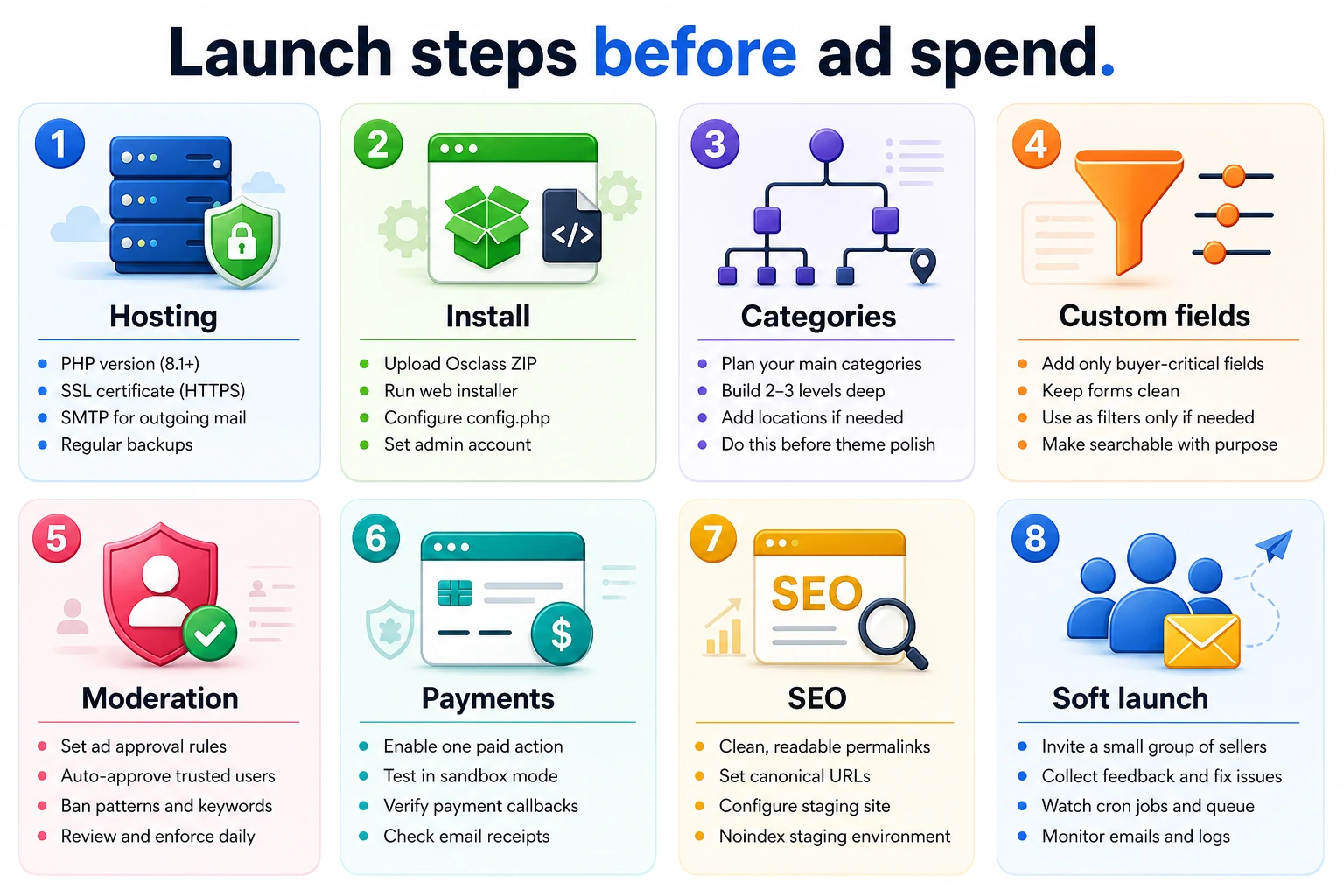
Reparenting categories after launch orphans fields and saved filters. Lock taxonomy in staging first. Nest only as deep as buyers browse.
Use hosting with monitored PHP and MySQL versions and known backup and mail paths. Test every payment, messaging, or map plugin on the same PHP minor as production. Keep web PHP and CLI PHP identical when cron runs from the command line; a common failure is a fine browser while expiry and mail jobs die under cron.
Document listing states before go-live: publish, pending review, active, promote, expire, renew. Set expiration and max renewals to the niche (often 30-60 days for local goods). If launch expects concurrent browse traffic, set OSC_CACHE and keep login, publish, and payment callbacks out of full-page HTML cache. Finish SMTP, cron ownership, and one sandbox payment callback before the first public post. Hosting choices: shared, VPS, or cloud.
Do not charge into an empty marketplace. Start free in the primary category, then paid visibility once sellers see responses. Typical sequence: one Featured-style product, then pay-per-post or category fees, then memberships. The UI must show placement, duration, and failed-payment behavior. In staging, walk success, fail, pending, and duplicate callbacks; confirm an operator can mark paid and apply Featured, Move to Top, or Highlight when the webhook never arrives.
Classifieds multi-seller means many users post ads and buyers contact them. Osclass Pay collects platform fees for visibility and access. Fee matrices: monetization playbook.
Set Settings > Permalinks before indexing; do not change slug patterns after the first crawl. One language strategy only (path or subdomain; core forbids both). Index category and location pages only with listings; noindex empty search and thin filter combinations. Help pages should state posting rules, fees, moderation turnaround (hours), and support email. Confirm sitemap hubs after seed inventory. Keep title templates factual (title, category, city), not slogan text. After Softaculous, verify robots.txt does not block oc-content assets themes need for Open Graph images.
*@domain.com; allowlist payment callbacks before Bot Fight Mode (cron and PHP-CLI notes).Publish FAQs and canned replies for the top five ticket types before support overload becomes the product.
Weekly: moderation backlog (pending, spam, reports), top search failures, ticket categories. Monthly: plugin updates, backup restore drill, crawl anomalies, PHP and plugin compatibility. Staging first; write the rollback before deploy. Separate day-to-day moderator accounts from roles that can edit payment plugins, rewrite rules, or cron. After any deploy, check Search Console for accidental noindex, broken canonicals, or a robots.txt change that rode in with an unrelated commit.
| Window | Focus |
|---|---|
| Days 1-30 | Publish and moderation flow, ticket types, posting rules, cron last-run. |
| Days 31-60 | Search filters on searchable custom fields; one paid feature with clear price and duration. |
| Days 61-90 | Load-test search and uploads; restore drill; PHP minor check on staging; resize host only if needed. |
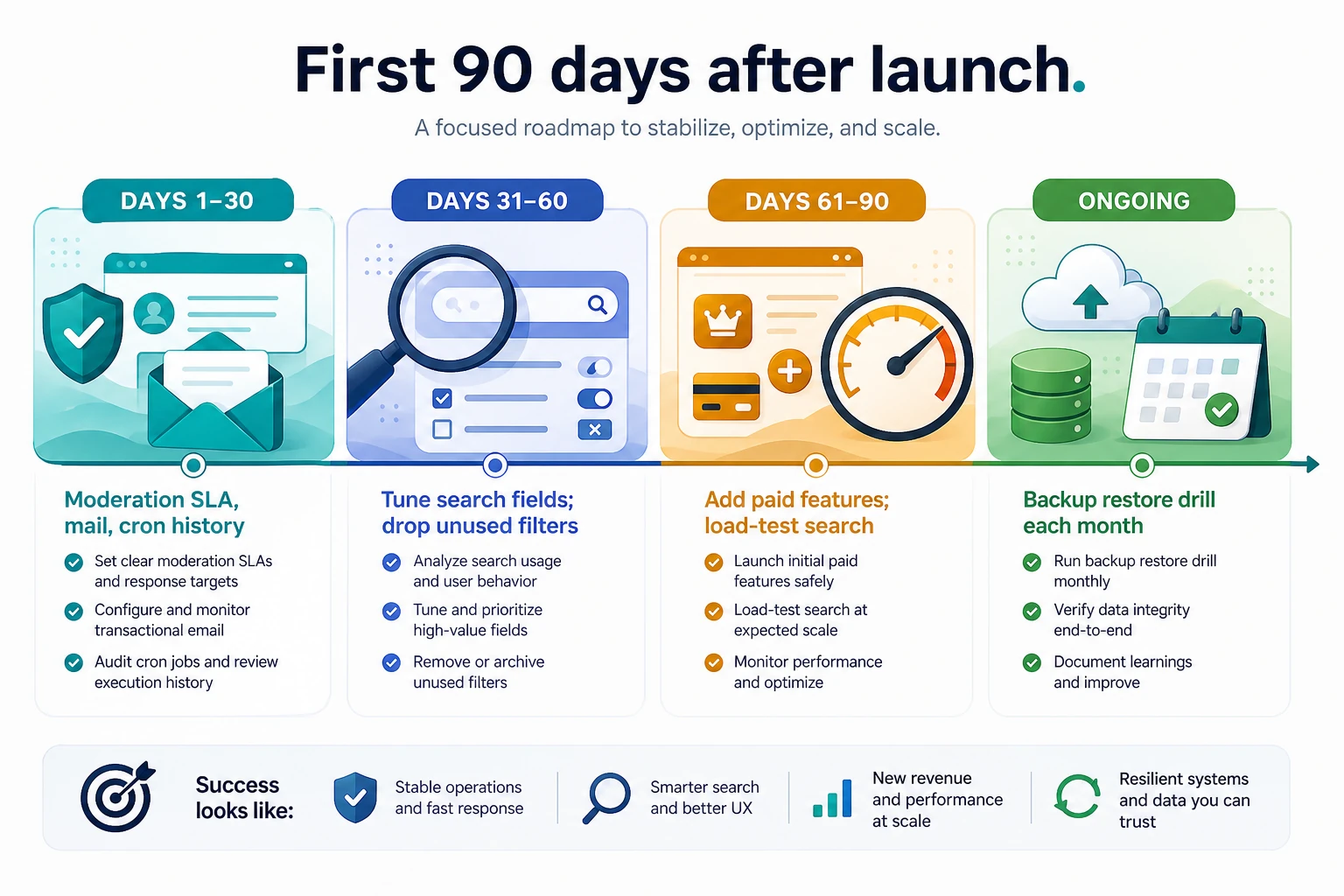
Do not buy traffic or stack plugins while publish or payment is flaky. Use days 61-90 for staging payment and upload load tests before production spend.

This article was last updated on 15. October 2026.