A Powerful Classifieds Script Packed with Features

Everything you need to launch, manage, and grow a successful marketplace website.

Osclass is a standalone PHP classifieds and marketplace platform: listings, users, search, locations, monetization hooks, and a full backoffice in one package. The sections below mirror what you actually get in core—listings management, international tools, permalinks, alerts, statistics, themes, plugins, and maintenance utilities—so you can plan a project without guessing what is “plugin-only” versus built in. For a line-by-line record of what changed in each release (for example PHP 8.5 support, session and cookie hardening, utf8mb4 and emoji handling, custom search rules, and action logs), see the changelog.

Highlights at a glance

  • Unlimited structure
    Categories (including deep nesting), listings, users, and custom fields scale with your niche—from vehicles and real estate to services and jobs.
  • Full backoffice
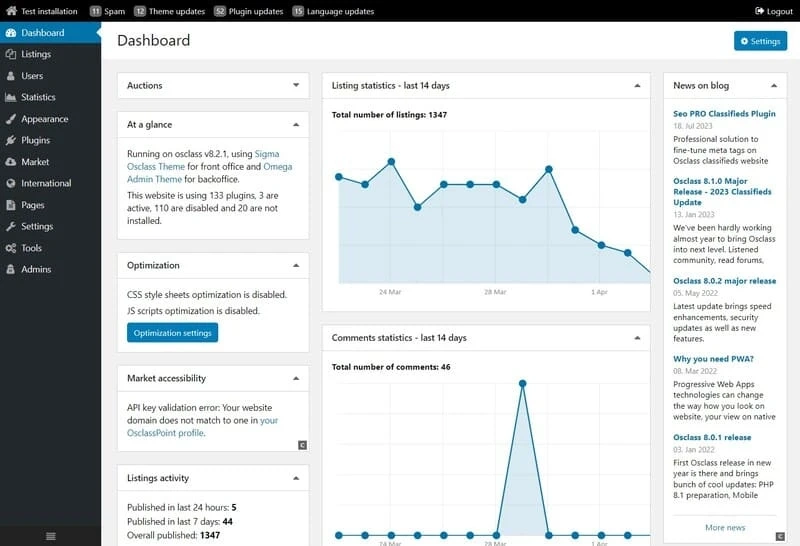
    Dashboard, listings (with comments, media, reports, and per-listing settings), users, statistics, appearance, plugins, market, languages, pages, and granular settings.
  • Search and URLs
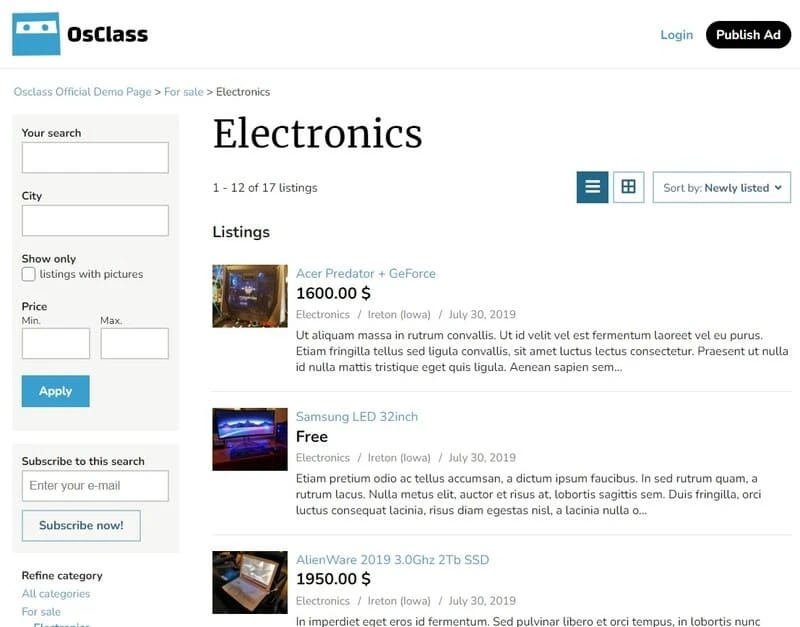
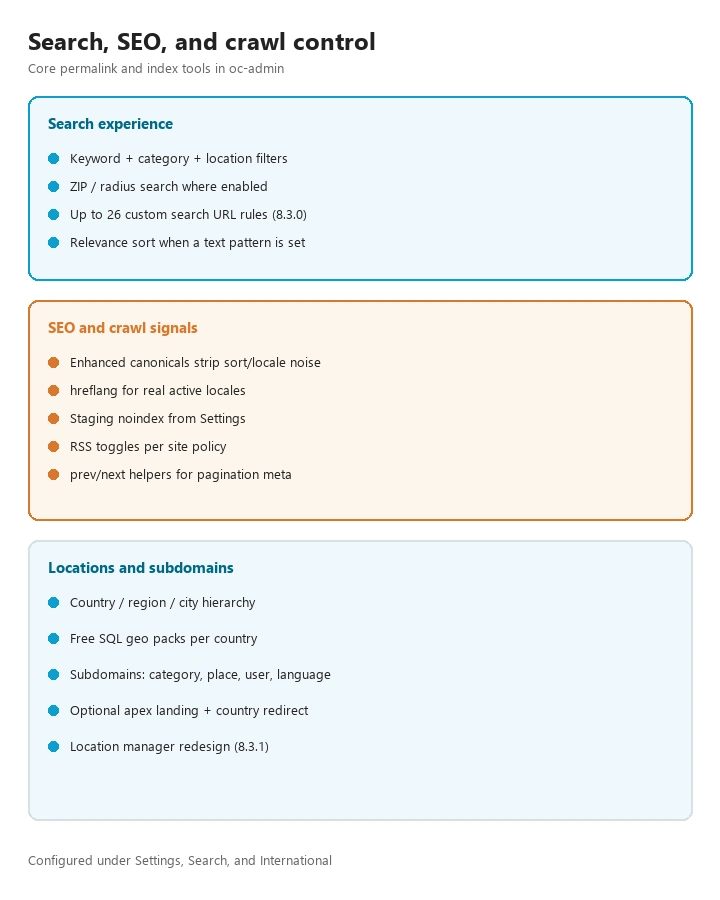
    Location hierarchy, ZIP-aware search, relevance ordering, optional custom search rules, permalinks, canonical and hreflang options, and saved search alerts.
  • Operations and trust
    Ban rules with hits and expiry, action logs with retention, mail server and template management, spam and bot controls, backups, import, and maintenance mode.
  • Modern media and content
    Configurable uploaders (including Uppy-based flows where enabled), image reordering on listings, static pages and widgets, and rich text in the admin where supported.
  • Open and extensible
    Themes, child themes, plugins, hooks, and the official market for extensions—without locking you into a hosted SaaS model.

Listings, categories, and custom data

The Listings area in oc-admin covers the full lifecycle of ads: browse and moderate listings, open each record to edit title, description, price, category, expiry, publish date, coordinates, and media, review comments attached to items, manage uploaded media, and process reported listings. Administrators configure custom fields (per-category meta such as mileage, surface area, or salary range) and global listing-related defaults from the same menu group.

Categories under Settings let you shape the taxonomy (including configurable maximum depth on supported versions), while the front-end search and publish forms follow that structure automatically.

Users, alerts, and safety

Core Users management includes registration and profile data, moderation from the list and detail screens, and ban rules to block abusive IPs, e-mail patterns, or ranges—with statistics on how often a rule matched and optional expiry so old bans age out cleanly.

When alerts are enabled, administrators can inspect subscriptions from the backoffice while end users can adjust alert frequency from their account on recent releases. Alerts respect bans and validation rules so mail volume stays sane.

Admins and moderator roles separate everyday listing work from sensitive configuration; moderators can be limited to specific plugin screens when needed.

Statistics, market, and reporting

The Statistics section aggregates views on listings, user activity, comments, and abuse reports so you can see trends instead of raw database tables.

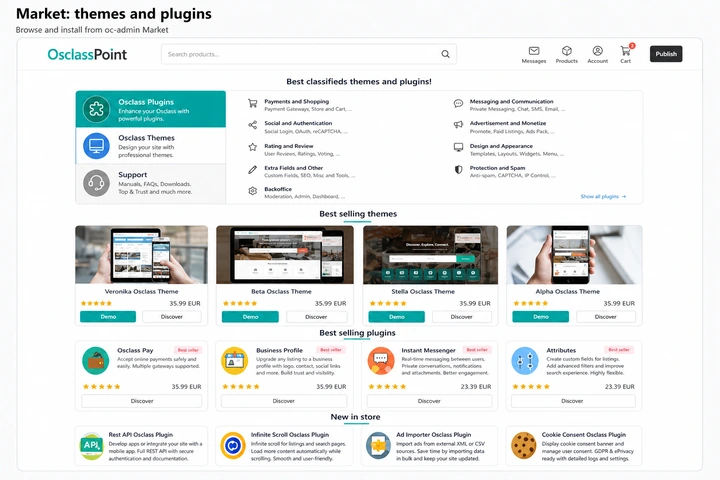
The in-admin Market connects to the official ecosystem for themes, plugins, languages, and location packs—so upgrades and add-ons stay discoverable from the same UI you use to run the site.

International: languages, locations, currencies

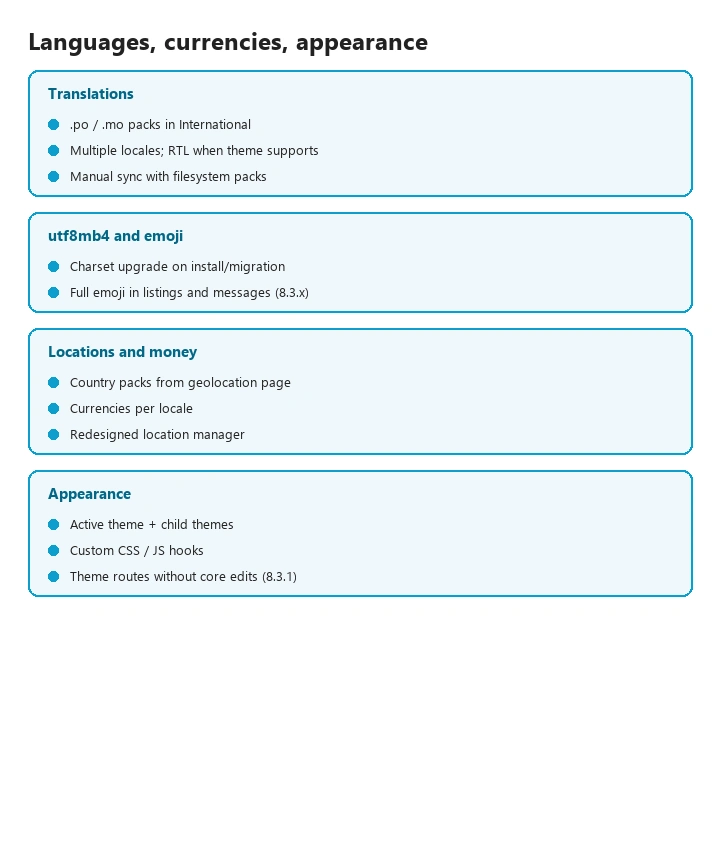
Under International you maintain translations, active languages (including RTL locales where applicable), the geographic locations tree (countries, regions, cities), and currencies. Recent versions add conveniences such as syncing language files from disk, per-locale default currency, and safer handling of locale codes in URLs and e-mail templates.

Appearance: themes, widgets, customization

Appearance controls which theme is active, how widgets are placed, and site-wide customization options (including hooks for injecting snippets such as custom JavaScript on selected front-office locations where the version you run exposes it). Child themes let you override a commercial theme safely while keeping parent updates practical.

Settings that shape the whole site

The Settings menu is where Osclass most differs from lightweight scripts. In addition to general site options you will find dedicated screens for categories, e-mail templates, mail server (SMTP and related diagnostics), comments, media (limits, optimization, and uploader choice where available), spam and bots (including reCAPTCHA-style protections), breadcrumbs, permalinks (including advanced custom search rules on supported builds), latest searches retention, front-end optimization of static assets, and subdomains and advanced routing for multi-city or multi-country installs.

SEO-oriented switches include enhanced canonical URLs, optional hreflang output for multilingual sites, RSS feed toggles, and a backoffice option to block search engine indexing during staging or migration.

Tools: maintenance, logs, and upgrades

Tools bundles utilities you normally patch together by hand on smaller scripts: configuration summary, data cleanup with safe batch limits on very large tables, searchable action logs with retention policies tied to cron, debug and error logs (including picking arbitrary .log files under oc-content on recent versions), SQL import, database backup, guided upgrade, per-country and per-category stats, maintenance mode, and the built-in changelog viewer.

Cron integrates hourly, daily, and other tasks (including instant alert dispatch on minutely schedules where configured). Administrators can use documented query parameters to force or print a cron summary for troubleshooting.

Static pages, e-mail, and RSS

The Pages module stores editorial or legal content with versioning-friendly editing in the admin. E-mail templates cover registration, listing events, contact forms, and more; variables such as locale codes can be mixed into subjects and bodies. Core can deduplicate accidentally duplicated templates after plugin churn.

The public RSS feed exposes listings to readers and syndication partners; it can be disabled cleanly when you do not want aggregation.

Developer-oriented extensibility

Osclass exposes a wide hook and filter surface for themes and plugins (including structured data, widgets, item forms, search, and mail). Plugins register their own admin routes; themes may define custom routes pointing at theme, plugin, or shared “custom” files on supported versions. Helper additions such as row loaders, cookie and session helpers, and search utilities reduce boilerplate for custom modules.

This site’s documentation and developer article are the right next steps once you outgrow configuration-only changes.

Why this depth matters

Many teams outgrow “just post an ad” scripts once they need moderated communities, multilingual SEO, reliable mail, and observable operations. Osclass ships the second layer—permalinks, alerts, logs, backups, and role separation—so you are not forced to bolt on ten separate services before you reach production traffic.
Founders keep ownership of data and hosting; agencies reuse a known admin layout and predictable hooks across client projects. When you are ready to monetize, payment and premium listing features typically live in marketplace plugins, while the core keeps discovery, trust, and content management coherent.

Frequently asked questions

  • What core features are included in Osclass?
    Osclass includes listing management, categories, custom fields, user accounts, moderation tools, comments, media, SEO routes, multilingual tools, and plugin/theme support.
  • How does Osclass handle SEO for classifieds websites?
    Core supports SEO-friendly URLs, canonical handling, sitemap generation, and structured fields for listings and location filters.
  • How are payments added to Osclass?
    Payments are added through plugins such as Osclass Pay, which can enable paid listings, featured ads, wallets, and payment gateways.
  • Can Osclass be customized without editing core files?
    Yes. Production marketplaces should use hooks, themes, and plugins so upgrades remain maintainable and conflict risk is lower.