Pick a classified ad script by scoring update safety, moderation, payment callbacks, and filtered search, not feature checklists. Online presence still depends on inventory you can index and sellers who get replies on your own domain. Two demos can look identical and behave very differently after six months of listings, paid bumps, and plugin updates.
This comparison covers self-hosted scripts for Craigslist, eBay Classifieds, or OLX-style ads (not auctions). Record export limits, URL control after a plan change, and whether rollback needs a vendor ticket. Named products on a typical shortlist (Flynax, LaraClassifier, ClassiPress, AWPCP, Open Classifieds, Yclas) are in the table below. Pair with WordPress listings ops tradeoffs, HivePress ops comparison, and DJ-Classifieds inside Joomla when those products are already on the shortlist.
For classified advert solutions, online presence means category and city pages with real inventory, listings that rank under your brand, and sellers who get replies. Software that wins that outcome usually shares these traits:
Osclass fits that list as a free open-source classifieds script (~7 MB core, no WordPress host). SaaS builders fit teams that will not run PHP, cron, or backups. WordPress or Joomla fit when editorial CMS already leads and listings are a module. Score candidates with the pilot matrix below before you buy themes or traffic.
Log dataset size, filter complexity, latency ranges, callback failure rates, and recovery time. Note PHP and plugin versions tested. Do not claim universal fit from one staging run. Run every candidate on the same hosting class, the same listing import, and the same admin accounts so scores stay comparable.
Scoring only works if each metric has a unit and a fail line. Record numbers, not impressions. For response time, use percentiles: p95 is the time below which 95% of requests finish (typical slow-but-acceptable case); p99 is the time below which 99% finish (tail latency that still affects real users during peaks).
| Metric | How to score | Fail line |
|---|---|---|
| Runtime efficiency | p95 and p99 on search and listing-detail with category, location, and custom-field filters | p95 filtered search over 2s on the shared 1,000-listing import, or filters that are only fast on unfiltered home |
| Moderation | Reports processed per admin hour; bans, queues, admin logs | No log of who changed listing state |
| Payments | Success, pending, failed, duplicate callbacks; time to reconcile gateway success | Duplicate credit, or no manual path if the callback never arrives |
| URLs and data exit | Canonicals, noindex on thin filters; CSV/API export of listings and media URLs | Filter permutations indexed; export caps listings, strips media, or needs a ticket to leave |
| Updates | Staging process, one practiced restore, readable changelogs | No restore rehearsal |
| Cron and mail | Expiry last-run timestamps; SMTP to a real inbox | Expired listings still public |
| Recovery | Minutes from failed deploy to verified publish, search, and payment URLs | Restore never tested |
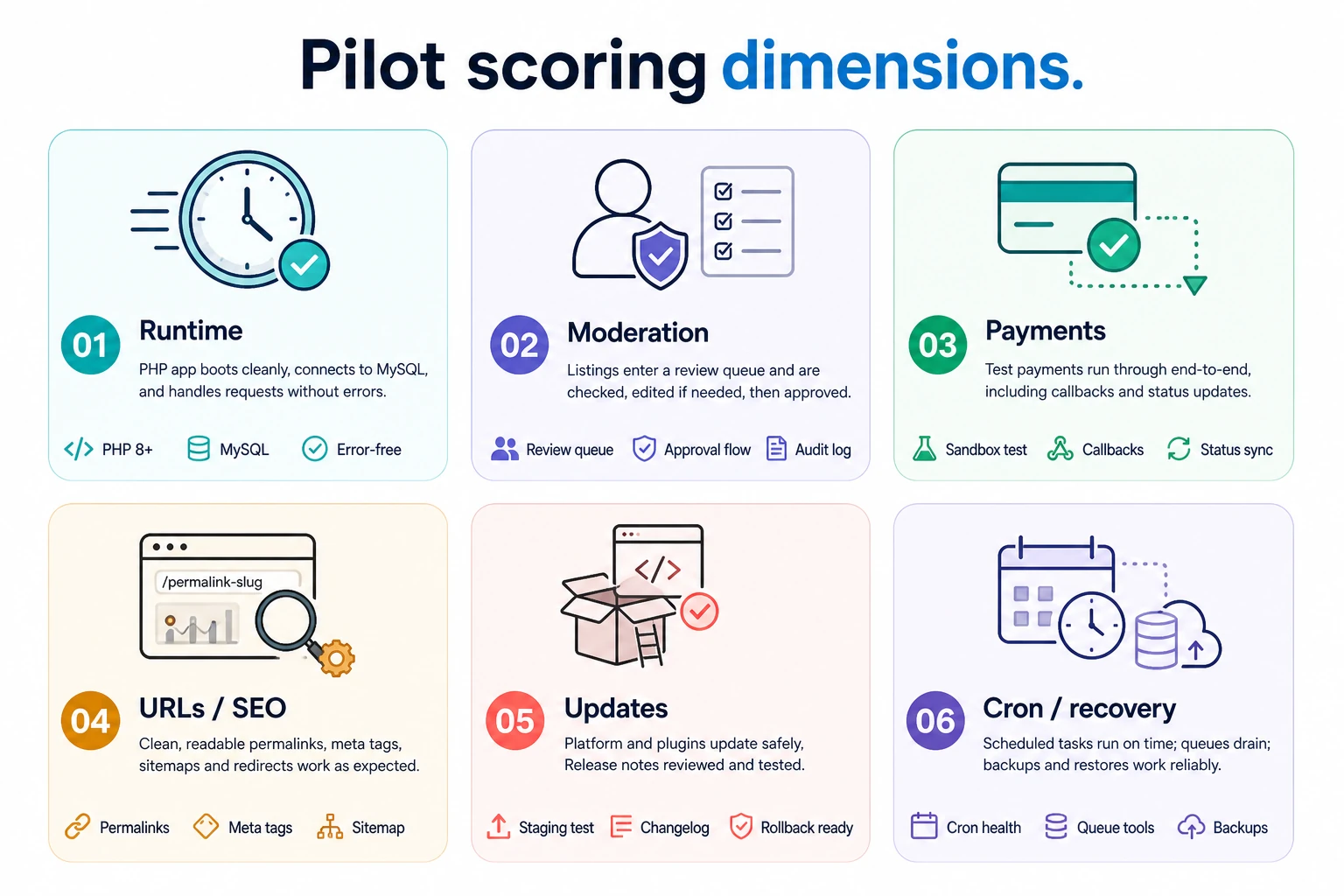
Weight scores toward the weekly work the team already does. A stack that wins a feature spreadsheet and loses on callback recovery still loses after go-live.

| Type | Update risk | URL/data control | Cost driver |
|---|---|---|---|
| Standalone classifieds platform | Low: one codebase owns the listing workflow; no separate PHP framework host | Full control over routes and export | Hosting plus occasional plugin/theme work |
| CMS-based stack (WordPress, Joomla) | Higher: CMS lifecycle plus every plugin retested per release; WordPress ecosystem: Patchstack 11,334 findings in 2025 (mostly plugins/themes) | Good, shared with CMS routing rules | Plugin licenses plus more QA hours; host-layer package and advisory surface |
| Enterprise commerce CMS (Magento / Adobe Commerce) | High: large codebase, frequent Adobe/Magento security patches, extension compatibility matrix | Full when self-hosted; heavy ops cost | Engineering and patch hours; typically overkill for classifieds-only products |
| SaaS builder | Low, vendor-managed | Limited: hosted URLs, restricted export | Recurring subscription, scales with listings |
| Custom framework | Depends entirely on in-house testing discipline | Full control by design | Engineering payroll for every feature and patch |
Difference: release retest cost and who owns the data if the team leaves.
Buyers usually shortlist a paid PHP script, a Laravel app, a WordPress theme or plugin, and an older open-source project beside Osclass. License and host decide the pilot. Prices change, so re-check the vendor page before you buy. Do not copy a star rating from a feature grid.
| Product | What it is | License and host | What to test |
|---|---|---|---|
| Osclass | Standalone PHP classifieds. About 7 MB core. No WordPress or Laravel host. | Free core, Apache License 2.0. You self-host. | Same pilot as every other row: p95 filtered search, moderation log, payment callback, export, cron, restore. |
| Flynax | Standalone PHP classifieds CMS (own MVC, Smarty templates, MySQL). Not WordPress. | One-time license for one domain and its subdomains. Unencrypted source. Premium templates, premium plugins, and mobile apps are separate purchases. | Which gateway and SEO pieces are in the basic license, and who ships patches after the included support month. |
| LaraClassifier | Laravel classifieds app, also sold as LaraClassified (BedigitCom on CodeCanyon). PHP 8.x. | Paid Envato license. You self-host and also maintain Laravel and Composer. | Framework upgrade path plus the same callback and filtered-search pilot. |
| ClassiPress | Paid WordPress theme from AppThemes. Not a standalone script. | Lifetime theme license. AppThemes states updates are complimentary for the first 12 months. Runs on WordPress. | WordPress core, theme, and plugin retest after every PHP bump. See the WordPress comparison. |
| AWPCP | Another WordPress Classifieds Plugin. WordPress plugin, not a separate CMS. | Free plugin core on WordPress.org. Paid add-ons exist for some workflows. | Publish and search after a WordPress core update, with only the add-ons you will keep. |
| Open Classifieds / Yclas self-hosted | Older open-source PHP classifieds, later branded Yclas. | Self-hosted. Public changelog lists 4.4.0 on 12 January 2022 as the latest release. | Whether security patches still ship, and whether a Pro license is required for the features in the demo. |
| Yclas Neo | Hosted classifieds from the Yclas team. Separate from the self-hosted script. | SaaS. The product about page says it is not a self-hosted download. | Export format, how long a cancelled site keeps data, and whether you can keep your URLs if you leave. |
Flynax states that prices for software, plugins, themes, and mobile apps are one-time fees, and that a basic license does not include premium templates, premium plugins, or mobile apps. Its order page listed the software license at 95 USD when checked in September 2026. Osclass is a free Flynax alternative for the same job: a standalone PHP classifieds script you self-host, with a free core under the Apache License 2.0 instead of that license fee. LaraClassifier listed 79 USD on CodeCanyon the same month, with a 26 September 2026 update note. Both paid numbers are vendor list prices, not a quote.
ClassiPress is the WordPress theme in this row. AWPCP is the WordPress plugin. HivePress is a third WordPress option and has its own ops comparison. Treat "WordPress plus a classifieds plugin" as one release surface, not three unrelated products.
Yclas self-hosted 4.4.0 (12 January 2022) is the latest release on the public changelog. Yclas Neo describes a hosted rebuild and says operators should not have to run servers. If a proposal says "Yclas", ask which product: the 2022 self-hosted script, or Neo on their host. Open Classifieds is the earlier name of that self-hosted line, not a second active codebase.
Validate PHP and database compatibility, cron behavior, SMTP to a real inbox, and cache/session interactions on the target PHP minor and one minor ahead. Record php -v for web and CLI (same minor), confirm upload and cache directories survive deploy/rsync, exclude payment success/cancel URLs from full-page cache, and match reverse-proxy Host / X-Forwarded-Proto to gateway return URLs.
Score first-install friction the same way. Osclass checks PHP 7.4+, CURL, MySQLi, GD, and writable oc-content paths; no Composer or Node. With DB credentials ready, the wizard is typically about 1-2 minutes after the ~7 MB ZIP uploads. Classifieds-ready WordPress still needs a listings plugin and often WooCommerce. Joomla plus DJ-Classifieds adds component, menus, modules, and ACL (PHP 8.1+ on recent Joomla). Magento and many Laravel/Symfony marketplace scripts need Composer and longer first deploys (installation guide).
Plugin count matters less than update quality. Check whether a monetization plugin changes search ordering in a predictable way, whether caching interferes with account widgets, and whether anti-spam rules can be tuned without custom patches.
Teams looking for a self-hosted Craigslist, eBay Classifieds, or OLX-style site usually want local or niche listings, category search, user accounts, and moderation without handing URLs and data to a hosted marketplace. That model is classified ads and business listings, not an auction house or full retail checkout. Osclass is built for the ads side: free open-source PHP, classifieds-first, ~7 MB core, no CMS or framework host. PHP 7.4+, MySQL or MariaDB, small enough for shared hosting early on.
Competing classifieds products on Laravel or Symfony pull a large Composer tree and a second CVE stream. CMS hosts such as Joomla or WordPress (including HivePress) still retest core, themes, and every extension per release; backups often grow into hundreds of megabytes once media accumulates.
Osclass also ships operator pieces many framework demos leave for later: .po/.mo catalogs (oc-admin, Poedit, or agency workflows), Market language packs, and country geolocation SQL packs. Current cores are fully compatible with PHP 8.5 and include HttpOnly/Secure cookie defaults plus utf8mb4 for emoji in listings. The 8.4.x line keeps the hook/theme upgrade path when plugins avoid removed APIs and stay out of core. Confirm each candidate's last core release date and whether plugin changelogs list breaking hooks before you score updates.
Install-base and CVE history should stay realistic. OpenCVE lists about 10 Osclass CVEs, mostly old 2.x/3.x (2012-2018). WebTechSurvey finds roughly 1,700 live sites (a few thousand at most). OsclassPoint's "120,000+ people chose Osclass" is adoption history, not a live census. W3Techs still fingerprints a large share of detectable installs on version 3, so upgrade urgency matters more than marketing security claims. WordPress runs on tens of millions of sites (Patchstack 11,334 ecosystem findings in 2025). Magento / Adobe Commerce sits around 100,000+ stores with dozens of Adobe Commerce advisories per year (54 tracked in 2025). Fewer Osclass CVEs means a thinner mass-scan target, not "unhackable." Patch 8.x, consider OC_ADMIN_FOLDER (and do not put that path in robots.txt), and keep staging backups. Confirm plugins on the same PHP minor before a production bump.
Osclass is not a clone of Craigslist layout or OLX policy; it is a self-hosted classifieds script under operator control. It fits when listings are the product. CMS stacks fit when classifieds sits inside an existing portal. Custom code fits odd ERP rules if engineers own patches. SaaS fits teams that will not run PHP, cron, or backups. Fee detail: Osclass Pay fee rollout.
Force each failure mode once during the pilot so the cause is written down before go-live. Keep owner, rollback path, and verification step in the runbook. Most rows apply to any classifieds stack; the spam row notes an Osclass-specific control example.
| What you see | Likely cause | How to verify |
|---|---|---|
| Listings publish but do not appear | Moderation state mismatch, category permissions, or delayed cron expiration reconciliation | Compare admin status to the public query; check cron last-run; confirm the category is enabled |
| Webhook success in gateway, no upgrade in app | Callback blocked by a firewall, signature mismatch after a proxy rewrite, or a duplicate ignored with no retry log | Hit the return URL from a sandbox charge; compare Host and HTTPS headers; replay one duplicate |
| Sudden spam surge | First-post controls disabled, weak captcha, or disposable email reuse | Count new accounts vs listings in 24 hours; enable first-post / admin approval; add Turnstile or equivalent and disable duplicate captcha plugins. (Osclass: Require Admin Approval + OsclassPoint Turnstile.) |
| Search pages slow after adding fields | Missing composite indexes, non-selective filters, or plugin joins on unindexed text columns | EXPLAIN the category plus location plus field query; turn off one new searchable field and remeasure the 95th percentile search time |
| Admin sessions randomly expiring | Cache serving session-dependent content, cookie domain mismatch, or mixed HTTP/HTTPS entry points | Log in, purge cache, reload dashboard; compare cookie domain and scheme to the live URL |
| Indexing drop in Search Console | Staging noindex left on, canonical loops, or duplicate language/route exposure | View-source robots and canonical on category and listing URLs; crawl filter variants |
| Image uploads fail intermittently | Temp directory full, PHP upload size mismatch, permission drift, or PHP memory too low for resize | Upload as the web user; compare php.ini; check uploads ownership; raise OSC_MEMORY_LIMIT if files stick in uploads/temp/ |
Sites behind reverse proxies should verify trusted headers and SSL redirect rules during evaluation. Misconfigured proxy handling causes login loops and broken callback signatures more often than platform code bugs.
Do not pick a platform until update and rollback are tested on staging. The gate is verified backups, a PHP upgrade path, and a repeatable release checklist. Skipping that step is how teams end up re-platforming 18 months later. A candidate passes only if someone actually ran this sequence:
If any step is left as a future task, the candidate is not ready. A backup never restored is only a file. After go-live, watch impression and click trends for 60 days; a real regression is a level shift across weeks, not day noise.
Run the same plan for every candidate, same dataset and hosting class. Mark pass, fail, or blocked, and write the failure, not only the score.
Demos skip most of this. A one-hour pilot finds callback and cron gaps fast. Keep the same plan after go-live so later upgrades compare against the original numbers.

This article was last updated on 2. October 2026.